Sunday, March 11, 2012

March Treats

Carmellitos 
(Thanks Mom!)

2 cups flour
2 cups oatmeal
1 1/2 cups brown sugar
1 teaspoon soda
1/2 teaspoon salt
1 1/2 cups melted butter
1-2 cups chopped pecans (optional-I left them out this time)
1 1/2 cups caramel ice cream topping (I used more like 2 cups)
6 tablespoons flour
2 cups semi-sweet chocolate chips

Combine first 6 ingredients.  Press 1/2 of oat mixture into a 9x13 baking dish.  Bake at 350 degrees for 10 min.  Remove rom oven and sprinkle chocolate chips on top, then add nuts (if you want them).  Combine caramel topping with flour and pour on top of chocolate and nuts.  Sprinkle remaining 1/2 of oat mixture on top.  Bake at 350 degrees for 15-20 minutes.  ***Reduce to 325 degrees for glass baking dishes.

Peanut Butter Balls
(Thanks, Sis!)

1 1/2 cups peanut butter
1 cup butter, softened
1/2 teaspoon vanilla
4-6 cups powdered sugar (to taste/consistency you like)
4 cups chocolate chips

Melt/soften butter.  Mix butter and peanut butter.  Add powdered sugar a little bit at a time until you have the consistency you like (I prefer more fluffy than buttery, which equates to more powdered sugar-closer to 6 cups).  Roll peanut butter mixture into balls onto a foiled cookie sheet (balls can be whatever size you want).  Place cookie sheet in freezer for 15 minutes.  Melt chocolate chips on stove or microwave.  Take peanut butter balls and dip them in chocolate.  After all balls are covered in chocolate, place cookie sheet back in freezer/fridge until ready to serve.  

The Holy Priesthood--for the blessing of God's children

When you hear the word 'Priesthood', what words come to mind?  Do you think of it's origin?  Do you ponder its power?  Its purpose, or even validity? Take a second and let yourself ponder on the Priesthood...
(After allowing for a moment of thought, I'll have the sisters shout out a few words or phrases that came to their minds)
I read this lesson over again specifically looking for words describing or referring to the Priesthood.  Here is what I found:  

Holy
Serious
Obligation
Eternally important
Blessing/Bless (the children of men)
Important
Great Honor
Opportunity
Service
Uplift
Develop
Divine power
Divine authority
Humble/humility
Responsibility
Administer (the ordinances of the Gospel)
Authority to speak in His name
Right to preach/teach the Gospel
Officiate
Servants of the Lord
Calling, ordaining, and setting apart for the work
Conferred upon men
Essential 
Qualify (men to teach and officiate)
Priceless
Opens the doors of the Celestial Kingdom
Partners with the Master of Heaven and Earth
Consciousness ("that I am my brother's keeper)
Example
Worthy 
Sacred trust
Power of God

Do any of these words/phrases stand out/have a greater impact on you?  Why?
Before we move on, let's define the Holy (Melchizedek) Priesthood.  The Holy Melchizedek Priesthood is the power of God delegated to man to act in His name (Manual, page 51). 

******************

From the life of George Albert Smith we gather that he clearly and reverently understood the great importance, necessity and privilege of the Priesthood.  

 (I will have someone read these two stories)
 (Story #1)
“I wonder sometimes if as fathers we take pains to explain to our boys the seriousness of the obligation assumed when a boy becomes a deacon. I wonder if when the boy is ordained a deacon the father lets him feel that he has something now that is eternally important. …
“I remember, as if it were yesterday, when John Tingey placed his hands on my head and ordained me a deacon. I had the matter so presented to me and the importance of it, that I felt it was a great honor. The re sult was, it was a blessing to me, and then after awhile other ordinations came to me. But in each case the foundation was laid in my mind that here was an opportunity for another blessing.”1

(Story #2)
“Rodney Badger was a teacher in my father’s home for years, and a great man. Whenever he came the family met and he sat and asked us questions and told us the things that he thought we ought to understand. And I want to tell you that when he came into our home he brought the spirit of the Lord with him. And when he went out we felt we had had a visit from a servant of the Lord.”2

First, I must pose the question, IS it important for men and women to learn about the priesthood?  (Yes!) Why?  (To understand the impact it has in our lives, to understand how it is we can attain eternal life, to develop our testimonies, to teach our children, to bless the lives of others, etc.) As mothers, what can WE do to help our sons and daughters understand how eternally important the Priesthood truly is?  (Teach them historical background, both ancient and latter-day.  Share personal stories where the Priesthood power healed, protected, etc. Be an example/point out examples.  Talk about both the obvious and not so obvious blessings of the Priesthood seen in the lives of those around you.  Be sure to define the Priesthood properly.  Place pictures and other tangible items in your home depicting the Priesthood power and the importance of it. i.e. picture of your Priesthood lineage all the way back to Christ). How can we help the young men prepare to be ordained to priesthood offices? (Teach both verbally and by example.  Make sure you USE the Priesthood-blessings etc.-and let them see you use it.  Bear testimony of it.  Read about it. etc.)

Jesus Christ restored divine authority to the earth during His mortal ministry.

To understand the importance of the Priesthood we must first understand where it came from, right?

"When the Savior came in the meridian of time, He found that great city of Jerusalem teeming with evil. The inhabitants were living in such a way that they had lost divine authority, so [God] sent His Son into the world and began again a Church possessing divine power. … There were those in His line who were good people, … and there were others who were still officiating in the Priesthood, but it was necessary for the Savior to come to restore divine authority. …
… When He began His ministry, He did not call to His aid the kings and rulers and priests and those who were high in authority, but He called the humble fishermen, and the result was that He gathered around Him men who could be taught, and not men who would not believe Him. He organized a Church under the direction of our Heavenly Father. He conferred divine authority upon His associates and directed them as to what they should do. … He had divine authority, and the righteous ones recognized Him to be the Son of God. Some think Him only to be a good man. We believe He came upon the earth not alone to teach the people what to do, but to confer on His associates divine authority to administer the ordinances of His Church. …
In the days of the Savior, He was the presiding authority. Next to Him came a quorum of twelve men, chosen by Him. When He passed away, the Quorum of Twelve, not a number of ordinary men who called themselves disciples, but a quorum of twelve men who possessed divine authority and had received it from Jesus Christ, became the leadership of the Church." (Manual, page 47)


Why was it "necessary for the Savior to ... restore divine authority" during His earthly ministry, in addition to teaching the gospel? (my thought was because there were righteous people who wanted/needed/deserved it, so he could give people the chance to grow, so he could hold people accountable, and because it fit the timeline/they were foreordained)

We know that the Priesthood was once again removed from the earth as people got more and more wicked.  At what point did we receive the blessing of the Priesthood?  How?  By whom?  

"When Joseph Smith was a young man the Lord directed him to translate the Book of Mormon. On one occasion when Joseph and Oliver Cowdery were translating, the Lord sent a holy being to answer their questions about baptism. Who was he that came? John the Baptist, who held the Aaronic Priesthood. Where did he come from? He came from heaven. … He appeared to Joseph Smith and Oliver Cowdery as a glorious resurrected being. He came directed by our Heavenly Father to confer the Aaronic Priesthood upon Joseph and Oliver, for it was not to be found any place in all the world. It was necessary that the heavens open and a man who had held the Priesthood, and still held it, should come and confer it.
Following that, Peter, James and John, who held the Melchizedek Priesthood, conferred that Priesthood upon Joseph and Oliver, and the Lord directed the organization of the Church, with a Presidency, consisting of a president and two counselors; also a Quorum of Twelve Apostles, a Patriarch, High Priests, Seventies, Elders, Priests, Teachers and Deacons; the same kind of an organization that existed in the primitive church, as far as authority was concerned.  (Manual, page 48)

Since the Restoration, "the Gospel and the Priesthood have been made available to all who qualify" to receive it.  Why do you think the Lord makes His authority available to all worthy men instead o restricting it to a few men with formal training? (to allow all men the chance to grow, to prevent corruption, to bless more people)

The power and authority of God can be found only in His true Church.

(I will either read an excerpt from this, or have someone else do it)

"I have had men ask me: “Of what benefit is your church more than some other church?” I have tried, in a tactful way, to explain to them the difference. Any organization may band together for worship, but that does not give them divine authority. Any group of churches may mass together and organize community churches. That does not confer divine authority. Men may unite for good purposes, but authority from our Heavenly Father is only obtained in his way, and his way in former days was by calling and ordaining men and setting them apart for the work. The same thing is true in our day. …

People should be made to understand that just to bow before the Lord in prayer does not give them divine authority. To live up to the requirements that are made of honesty, virtue, truth, etc., does not give them divine authority. … It is not sufficient that we pray, that we attend church. It is necessary that we possess divine authority, and it is the claim that we possess that authority that has brought upon this Church much of the persecution that has followed it from the beginning. But it is the truth and many of our Father’s children are beginning to observe the effect of divine authority in this Church. They see the development that is made in the lives of men and women." (Manual, page 50)

What do you make of that last sentence ("they see the development that is made in the lives of men and women")?  (I would think 'development' refers to the development of character/values-both in families and in individuals, testimony and a general understanding of God.)  What can we do personally to nurture the power and influence of the priesthood in our lives? (same as nurturing it in our children, I would think)  How would you respond if someone asked you "Of what benefit is your church more than some other church?"

I think it can be hard to answer such questions without (unintentional) offending someone.  We often fear responding for this reason but President Smith said it well when he said,

"I personally do not desire to be understood to be finding fault and criticizing the people who belong to the various denominations of the world. I am thankful that there are in so many of them good men and good women who believe in him and with the light that they have serve God; but the fact remains that our Father has established in this world, his Church. He has conferred upon men in this day his authority, and there is no other authority in the world that he will recognize but that which he himself has instituted."

Priesthood ordinances are essential for us to enter the Celestial Kingdom

One of the reasons the priesthood is so priceless is the sheer fact that we can not enter the Celestial kingdom without it.  Every good person, doing good things, is blessed.  But regardless of how virtuous we are, without the priesthood, we cannot attain that degree of glory we are all striving for.  

What would happen if we were denied this blessing of the priesthood?  What would our lives be like? 

"It would mean that there had been closed to us the doors of the celestial kingdom. It would mean that the crowning blessing toward which I have been taught to look since I was a child would not be realized. … The companionship of my loved ones, … who are dear to me almost as life itself, could not be enjoyed in the celestial kingdom."

What are some of the "priceless blessings" you have received because of the priesthood?  Or, oppositely, what blessings do you feel you missed out on because you didn't/don't have the priesthood in your home? (Mom's story of growing up with a dad who wasn't a member vs. her sisters who grew up with a dad who was) I think of the blessings I received, the examples I saw, and the strong, righteous leadership both in my home and in the ward I grew up in. 

Priesthood holders have a responsibility to live exemplary lives and use the priesthood to bless others.

The priesthood is an endlessly powerful blessing and it comes with many responsibilities.   
"You cannot go out into the world in any other Church or in all other Churches and find … men holding divine authority. Do not forget that. You belong to a choice body of men, … having had hands laid upon them, and receiving divine authority, making you partners with the Master of Heaven and Earth. I do not mean that you can’t laugh, smile, and enjoy life, but I do mean that there should be deep in every soul a consciousness that “I am my brother’s keeper. I hold authority from the Lord Jesus Christ—I am a bearer of the Holy Priesthood.” If we will do this we will not be found trifling with sacred things as some have done in the past." (Manual page 52)
This makes me think of the phrase "with great power, comes great responsibility." What power on this earth is greater than the priesthood? (I'd say none) Those that hold the priesthood certainly have the responsibility to bless the lives of others and to be an example of the Savior, for their job is to act in His stead.  It is not their job to lord over anyone, but to be humble teachers and leaders. "The authority of our Heavenly Father is upon the earth for the blessing of mankind, not to make those who receive that authority arrogant, but to make them humble; not to make those who have received special privileges feel that they are greater than others, but to make us humble in our souls, prayerful in our hearts, and considerate of all men in all that we do, and thus exemplify by upright lives that which our Heavenly Father desires us to teach."(Manual page 53)  The power of these priesthood holders comes when they live worthily of that sacred trust and divine authority.  As mothers, spouses, sisters, etc. how can we help the men understand both the responsibilities of the priesthood, and the blessings of the priesthood?  (study together, express a need for the priesthood, recognize and show gratitude for the blessings that result from the priesthood in your home/life, show a sincere respect for the priesthood both in word and deed) How can we help them stay worthy of their priesthood? (never put them in a position that would compromise their integrity etc., hold them to a high standard, hold yourself to a high standard, etc., point out the blessing you receive from staying worthy, etc.)

The take home message from this lesson, I think, is simply a reminder of the power of the priesthood and it's sacred origin, purpose, and requirements.   In homes where membership in the gospel spans generations, the priesthood often becomes common place.  What can we do to help our families keep a fresh perspective on the priesthood and keep it the sacred blessing that it truly is?  (One of the ideas that comes to mind is to learn about and teach your children what the responsibilities of the priesthood are.  And then, of course, make sure you do/participate in them.)

"Wherever you go, keep in mind the fact that you represent him who is the author of our being. The priesthood that you hold is not the priesthood of Joseph Smith, or Brigham Young, or any other men who have been called to leadership of the Church at home or abroad. The priesthood that you hold is the power of God, conferred upon you from on high. Holy beings had to be sent to earth … in order to restore that glorious blessing that had been lost to the earth for hundreds of years. Surely we ought to be grateful for our blessings.23
I pray that the Lord will bless us all, that we will be worthy to bear the priesthood that He has offered to us and conferred upon us, that wherever we go people will be able to say, “That man is a servant of the Lord." (page 53)

I absolutely know that the power of the priesthood is endless, that the Lord gave us the priesthood to bless us, and that the priesthood unlocks the keys to the celestial kingdom.  It is my prayer that we continually ponder the blessings of the priesthood, that we choose to utilize them in our homes, and that we strive to help the priesthood holders around us prepare for and remain worthy of the privilege and responsibility of bearing the priesthood. 


Saturday, January 21, 2012

Our Testimony of Jesus Christ


I would venture to say that the core doctrine of our religion is indeed our belief in and testimony of our Savior, Jesus Christ. Without Him we are nothing, and so is our doctrine.  President George Albert Smith knew this well.  

"I have been buoyed up and, as it were, lifted out of myself and given power not my own to teach the glorious truths proclaimed by the Redeemer of the world. I have not seen Him face to face but have enjoyed the companionship of His spirit and felt His presence in a way not to be mistaken. I know that my Redeemer lives and gladly yield my humble efforts to establish His teachings. … Every fiber of my being vibrates with the knowledge that He lives and some day all men will know it."

"In his travels as a General Authority, George Albert Smith occasionally met those who thought that the Latter-day Saints do not believe in Jesus Christ. This misconception amazed and worried President Smith, and he tried to correct it by sharing his personal witness of the Savior.
On one occasion he spoke at a Church meeting in Cardston, Canada, about the life and mission of Christ. The next morning he went to the railway station to buy a train ticket. While he waited in line, he overheard a conversation between a woman and the ticket agent. The woman mentioned that the evening before she had decided to attend a Latter-day Saint worship service.
The ticket agent looked surprised. “My goodness,” she said. “You do not mean to say you went to church there.”
“Yes, I did,” the woman answered. “Why not?”
The ticket agent said, “They do not even believe in Jesus Christ.”
Then the woman replied, “Only last night I listened to one of the elders of the Church speaking of the life of Jesus of Nazareth, and I have never heard anybody who seemed more profoundly impressed with a knowledge that Jesus was indeed the Christ, than the speaker on that occasion.”1

Why would someone's personal opinion that Mormons do not believe in Christ bother any member of the church (not just the prophet)?  Easy, right?  Because, again, it is our core doctrine.  So let me ask you this, what have you done, or will you do when you come across someone who truly doesn't understand our belief in Jesus Christ?
 (Ideas: ask he/she what gives them that impression, simply bare a powerful testimony and leave it at that, share a quote/testimony from a prophet/apostle, share "The Living Christ" with them start a discussion, go over doctrine etc., walk away if it looks like something that will only end in Bible bashing, hurt feelings, etc.) 
If you're anything like me, you'll simply state your testimony in a logical manner.  In doing so, you'll likely define who Jesus is (The Christ, our resurrected Savior and brother).  In doing so you'll probably reference the testimonies given in (a.) the Bible and (b.) Book of Mormon (and Doctrine in Covenants), (c.) the testimonies of modern day prophets, and/or (d.) a private, personal witness directly given to you from the Holy Ghost. 

 (a.) We Accept the Bible's testimony of the divine mission of Jesus Christ

President George Albert Smith addresses each of these testimony building resources.  In regard to the Bible, he described how wonderfully definitive it is in describing and determining who Christ is; we believe all it teaches in reference to Him and we accept the testimonies of all the evangelists in the New Testament ("with reference to the resurrection of the Redeemer of mankind"). 
-Are there any particular scriptures/stories/principles in the Bible that have had a profound impact on your testimony of Christ?
-Which story do you think best describes Jesus Christ's character and divinity? (example: Christ's baptism, the dove and the voice of God Matthew 3:13–17)

(b.) The Book of Mormon and the testimony of (c.) Joseph Smith give us additional evidence of Christ's divinity

In John 10:16 Jesus promised, "Other sheep I have which are not of this fold; them also I must bring and they shall hear my voice; and there shall be one fold and one shepherd."  The Book of Mormon testifies to the truthfulness of this statement.  It bears witness that Jesus did indeed fulfill the promise he made in Jerusalem.  "He came in his resurrected body to bring them the information he had predicted should be given to those to whom he now ministered." (Teachings Of George Albert Smith)

Additionally, The Book of Mormon is just like the Bible in the sense that it is full of prophets and apostles testifying of Christ.  Whether they saw Him, heard His voice, were visited by angels, or had the Holy Ghost testify to their hearts, these righteous men testify of Him.  They describe generations of people who both followed Him and rebelled against Him.   

The Book of Mormon clarifies questions many have argued for centuries.  For example, there are those that refute Jesus' divine origin because "He was born as a little child, cradled in a manger, His mother being Mary and his reputed father Joseph the carpenter.  Many have admitted that He was a great and good man, but they have desire to rob Him of the divinity of His birth."  (T.O.G.A.S.)  This thought is refuted and proved false in the Book of Mormon.  In it, we read of Jesus gloriously descending in the clouds heaven, this time as a man, not a little child.  As we read accounts of Jesus Christ and his doctrine in the Book of Mormon we clarify who He was/is and what His doctrine is all about.  
-Is there any particular example of this in the Book of Mormon that has bolstered your testimony?
(One of my examples would probably be Jesus' love for and understanding of the little children.  How He treated them says nearly everything I need to know about our Savior and the love He truly has for us all)

Referring to the Book of Mormon people and their experience with Christ, President Smith said, "Those were not hallucinations, but experiences of such marvelous character as to be remembered forever by those who experienced them.  As Latter-day saints we accept this record as evidence of the resurrection of Jesus Christ our Lord."(T.O.G.A.S)

We are also buoyed up by the the powerful testimony of Joseph Smith and subsequent prophets and apostles.  Joseph Smith in particular "saw God the Father standing in the clouds of heaven, clothed with glory and Jesus Christ, the Redeemer of the world, exalted at His right hand, and he heard the voice of the Lord saying, 'This is My Beloved Son, hear Him.'" [ Joseph Smith—History 1:16–17.]  President Smith convincingly argues, "To my mind, one of the strongest testimonies of the divinity of the life of our Savior is the testimony of Joseph Smith who laid down his life as a witness of the truth of the gospel of Jesus Christ."
-Has your testimony of Christ been strengthened by something you heard (or read) a prophet say?
(My example would be the same of President Smith's.  Nothing has spoken more powerfully to me than the words of Joseph Smith and the life he so willingly gave as a martyr.)

Though not specifically mentioned in this lesson, the Doctrine and Covenants certainly fit in the category of testimony building when it comes to our Savior.  
-Can anyone share an example of a scripture/story in the Doctrine and Covenants that has spoken to their hearts and built their testimonies?
(My little sister will share her "life changing" scripture)
I also want to remind you (as my sister reminded me) of the amazing document we have from the First Presidency and the Council of the Twelve Apostles, the Living Christ Reading it leaves no question in my mind who Christ is and where his doctrine will take us.  (I've added the Living Christ to the bottom of this lesson)

(d.) Each of us can gain a personal testimony that Jesus is the Christ

Perhaps one of the more distinguishing characteristics of our faith is our belief in modern revelation.  We believe in a prophet who receives revelation for the word but just as important, we believe in receiving personal revelation.  It is our right and privilege to receive a witness from the Holy Ghost of whatsoever things are true...including whether or not Jesus is the Christ.
"My doctrine is not mine, but his that sent me.  If any man will do his will he shall know of the doctrine, whether it be of God, or whether I speak of myself." (John 7:16–17)
This personal testimony is arguably the most powerful as it is "burned into our souls by the power of the Holy Ghost, when we have performed the work that the Lord has said must be performed if we would know that the doctrine be of God or whether it be of man." (T.O.G.A.S)
-What are these things President Smith refers to when speaking of the work that must be performed?
(faith in God, repented of sins, been baptized by immersion and received the Holy Ghost by someone with authority)

What a gift we have been given!  In a world where anyone can publish a book, compose a website, broadcast "news" etc., we don't have to wonder if we're hearing the truth.  We have the Holy Ghost to personally witness to us what is true and what is the cunning of the devil.  The Bible, Book of Mormon, and witnesses of the prophets and apostles are all solid, amazing evidences and testimonies of Jesus Christ.  BUT we can find our own witness down on our knees, alone, in an intimate conversation with the Lord.
 Our mission is to share with all people what we know about Christ

With so many resources for information (with reference to the divinity of the Savior) and opportunities to hear of Christ, we are a minority.  Very few of our brothers and sisters have the opportunity to learn as we do.  And, it's like every action movie says, "with great power comes great responsibility."  It is not only our pleasure, but our duty, our mission to share this Gospel and our testimonies of our Savior Jesus Christ with those around us.
President Smith begs us not to hide our candle under a bushel.  "Do not conceal the knowledge God has bestowed upon you from your fellows. Do no annoy them, but do not be unwise enough as to hide from the the gospel of Jesus Christ.  That is the only power of God unto salvation in the celestial kingdom." (T.O.G.A.S)

Hard as it may be, I think it's important for us to turn our agitation into urgency and excitement when we hear of those who do not think we believe in Christ. And when we come upon someone who is unfamiliar with our Savior, I would hope we'd cautiously, optimistically, and gladly take the time to teach him.  When our testimonies are solid, our hearts are full.  And when are hearts are full, we are happy.  That happiness is ours to share. 

"The happiest men and the happiest women that you know in the world are those who are conforming their lives to the teachings of the gospel of Jesus Christ. They are those who have the assurance of eternal life; they are those who understand the purpose of our being. … As I have traveled to and fro in the world bearing this message, my soul has been filled with joy, and my eyes have been dimmed with tears, when I have seen how perfectly men’s lives may be transformed by the gospel of Jesus Christ. I have seen those who were discouraged, those who were in darkness, those who questioned the purpose of their being, and when they have had taught to them the glorious truths of the gospel of Jesus Christ, they have changed, they have learned to be happy, to be contented, to be satisfied, to be enthusiastic in believing and teaching the gospel that was proclaimed by Jesus Christ when he dwelt upon this earth and traveled in Galilee.
Brethren and sisters, the world does not understand that, but it is our mission to assist them to understand it, and it is not with egotism, it is not with arrogance, but with charity for all, with loving tenderness, that this message is sent forth. …" (T.O.G.A.S)

Mine is not nearly as influential or as compelling as President Smith's (I hope you'll go back and read this chapter, he has a very clear and powerful testimony that simply needs to be read word for word) but I will leave you my testimony that Jesus is the Christ.  That he is the Son of God, and our brother.  He is both he who died on Calvary and He who rose three days later.  Jesus Christ is the only name by and which we will be saved.  How grateful I am to be one of the small in numbers who was born into this knowledge.  I know He loves me, and I love Him. 

(Below is the Living Christ)

The Living Christ: The Testimony of the Apostles

"The Living Christ: The Testimony of the Apostles," The Living Christ: The Testimony of the Apostles, (2000)
As we commemorate the birth of Jesus Christ two millennia ago, we offer our testimony of the reality of His matchless life and the infinite virtue of His great atoning sacrifice. None other has had so profound an influence upon all who have lived and will yet live upon the earth.
He was the Great Jehovah of the Old Testament, the Messiah of the New. Under the direction of His Father, He was the creator of the earth. “All things were made by him; and without him was not any thing made that was made” (John 1:3). Though sinless, He was baptized to fulfill all righteousness. He “went about doing good” (Acts 10:38), yet was despised for it. His gospel was a message of peace and goodwill. He entreated all to follow His example. He walked the roads of Palestine, healing the sick, causing the blind to see, and raising the dead. He taught the truths of eternity, the reality of our premortal existence, the purpose of our life on earth, and the potential for the sons and daughters of God in the life to come.
He instituted the sacrament as a reminder of His great atoning sacrifice. He was arrested and condemned on spurious charges, convicted to satisfy a mob, and sentenced to die on Calvary’s cross. He gave His life to atone for the sins of all mankind. His was a great vicarious gift in behalf of all who would ever live upon the earth.
We solemnly testify that His life, which is central to all human history, neither began in Bethlehem nor concluded on Calvary. He was the Firstborn of the Father, the Only Begotten Son in the flesh, the Redeemer of the world.
He rose from the grave to “become the firstfruits of them that slept” (1 Corinthians 15:20). As Risen Lord, He visited among those He had loved in life. He also ministered among His “other sheep” (John 10:16) in ancient America. In the modern world, He and His Father appeared to the boy Joseph Smith, ushering in the long-promised “dispensation of the fulness of times” (Ephesians 1:10).
Of the Living Christ, the Prophet Joseph wrote: “His eyes were as a flame of fire; the hair of his head was white like the pure snow; his countenance shone above the brightness of the sun; and his voice was as the sound of the rushing of great waters, even the voice of Jehovah, saying:
“I am the first and the last; I am he who liveth, I am he who was slain; I am your advocate with the Father” (D&C 110:3–4).
Of Him the Prophet also declared: “And now, after the many testimonies which have been given of him, this is the testimony, last of all, which we give of him: That he lives!
“For we saw him, even on the right hand of God; and we heard the voice bearing record that he is the Only Begotten of the Father—
“That by him, and through him, and of him, the worlds are and were created, and the inhabitants thereof are begotten sons and daughters unto God” (D&C 76:22–24).
We declare in words of solemnity that His priesthood and His Church have been restored upon the earth—“built upon the foundation of … apostles and prophets, Jesus Christ himself being the chief corner stone” (Ephesians 2:20).
We testify that He will someday return to earth. “And the glory of the Lord shall be revealed, and all flesh shall see it together” (Isaiah 40:5). He will rule as King of Kings and reign as Lord of Lords, and every knee shall bend and every tongue shall speak in worship before Him. Each of us will stand to be judged of Him according to our works and the desires of our hearts.
We bear testimony, as His duly ordained Apostles—that Jesus is the Living Christ, the immortal Son of God. He is the great King Immanuel, who stands today on the right hand of His Father. He is the light, the life, and the hope of the world. His way is the path that leads to happiness in this life and eternal life in the world to come. God be thanked for the matchless gift of His divine Son.

The First Presidency

signatures
January 1, 2000

The Quorum Of The Twelve

signatures of the twelve


Sunday, October 30, 2011

Halloween Treats

Your wish is my command!

Here's what I did for my cookies, Ladies:
The witches hat = shortbread, striped cookies from the dollar store (yes, that's right, the dollar store) + store bought orange frosting (I just had some on hand, but making it is delicious too.  Either way, I'd put it into a plastic bag, cut off a bit of one corner, and squeeze it onto the cookies) + your choice of Hershey Kiss (I had half milk and half dark).  Use your frosting as glue and put the two together, just make sure you put enough frosting down that it creates a ring on the outside of the kiss to look like ribbon around a hat.

(I didn't take a picture of mine but I found this online and these are dang close to mine-just more professionally done...photo from http://barbschram.blogspot.com/2009/07/witch-way-justrite-way.html)


Now the home made sugar/short bread candy corn cookies area recipe I got from a BFF here at school.  This is her recipe (thanks KT!):

(Short Bread) Sugar Cookies

2 cups butter, softened
1 (8 oz) package cream cheese, softened
2 cups sugar
2 egg yolks
1 3/4 teaspoon vanilla
4 1/2 c. flour (you made need to add up to 1/4 c. more depending on how sticky the dough is...you want it to be sticky but handable)


Cream butter and cream cheese until light and fluffy. Add sugar, egg yolks and vanilla; mix well. Gradually add flour. The dough will be VERY soft; don’t worry, it gets firmer after chilling. Cover and chill two hours or until firm. Roll out on floured surface to ¼ inch thickness. Cut into shapes and decorate with sugars; place on greased baking sheets (or use parchment paper). Bake at 350 degrees for 10-12 minutes or until set (but not browned). Cool 5 minutes. Place on wire racks to cool.

Now, using this recipe I followed the instructions on this website, ourbestbites.com (which is also where I got the picture below). 


Enjoy!


Waiting on the Road to Damascus


When I heard the name of this talk "Waiting on the Road to Damascus" I thought to myself, "why do I know that name? Damascus...hmmm."

I had two things working against me. The first? My memory, or lack there of. The second? I'm not a great scriptorian. I am the kind of person who remembers how she felt while somehow missing all the detail of an event/story. So for those of you who are like me, let me give you a brief refresher.

Damascus, is an ancient city of Syria. And the man, Saul, who was on his way there, who was he? When I heard the name Saul, I thought about Jack Warden's character in "While You Were Sleeping." Obviously that's not the right Saul. But then if you look for Saul in the scriptures there are two, so don't get confused like I did. There's a Saul that is talked about in the Book of Samuel, he's kind of tragic. Wrong Saul. The man President Uchtdorf talks about is the Saul in Acts, Saul of Tarsus. President Uchtdorf makes the assumption that we all know the story well. While I'm fairly certain that the majority of you have memories far superior to mine and absolutely know the account of Saul, there may be a few of you who are more like me.  Consequently, I want to share an excerpt from an article I found in "The Friend" way back in 1986 (link at bottom):

"The angry mob dropped their cloaks at Saul’s feet. Cursing and yelling, they began to hurl stones at Stephen for preaching about Jesus. The rocks bruised and cut Stephen’s body. Wounded, he knelt on the ground and cried with a loud voice, “Lord, lay not this sin to their charge,” and died.

Saul was unmoved by the innocent man’s dying words of forgiveness. He thought Christians were wicked, and he worked hard to rid the empire of them. He searched the towns and homes, and when he found any men or women who believed in Christ, they were put into prison.

So great was Saul’s vengeance that he went to the high priest and obtained letters to take to the synagogues in Damascus. The letters gaveSaul the authority to take prisoner any Christian he found on his journey.

Carrying the letters, Saul started for Damascus, determined to destroy the Christians. But as he neared the city, a light from heaven encircled him. Bewildered, Saul fell to the earth.

“Saul, Saul, why persecutest thou me?” asked a voice hovering near.

Frightened, Saul asked, “Who art thou, Lord?”

The voice answered, “I am Jesus whom thou persecutest.”

Trembling, Saul asked, “Lord, what wilt thou have me to do?”

“Arise, and go into the city, and it shall be told thee what thou must do,” the Lord instructed.

Obediently Saul arose, only to find that he was blind. Saul’s companions led him into Damascus, where for three days his blindness continued and he neither ate nor drank.

After the three days a man named Ananias was sent to Saul by the Lord. Putting his hands on Saul’s head, Ananias prayed, “Brother Saul, the Lord, even Jesus, that appeared unto thee in the way as thou camest, hath sent me, that thou mightest receive thy sight, and be filled with the Holy Ghost.”

Immediately Saul could see again. Saul now knew that Jesus was the long-awaited Messiah, and he asked to be baptized into His church.

For many days Saul remained with Jesus’ disciples, learning all that he could from them. Before long, Saul, the man who had persecuted Christians, was testifying of Jesus Christ in the synagogues. Nevertheless, many people continued to persecute the Christians. One time when the people decided to kill Saul, he escaped by being lowered over the city wall in a basket by some of the disciples. "


I think it's important to know the particulars of Saul's experience in order to fully grasp President Uchtdorf's message. Who can pick out some of the details that shed light on Saul's experience and are pertinent to what we are talking about? Here are a few ideas I came up with:
-Saul, even when he was even, was never sitting around waiting for something to happen
-He was passionate (both as a wick man, and as a righteous man)
-He was frightened by the Lord (those who are unprepared to meet Him will fear Christ)
-The event wasn't all angels and butterflies. He lost his sight and had to suffer a bit.
-Even though he was scared, he was still obedient
-Saul had to exercise faith to be healed and to receive his witness
-He then went forth, acquired as much knowledge as he could, and began to spread the gospel

Now, is Saul's the first manifestation of this kind? No. Was it the last? No.
(Let me share what President Uchtdorf said on the matter...)

"We know that manifestations such as this happen. In fact, we testify that a similar divine experience happened in 1820 to a boy named Joseph Smith. It is our clear and certain testimony that the heavens are open again and that God speaks to His prophets and apostles. God hears and answers the prayers of His children.

Nevertheless, there are some who feel that unless they have an experience similar to Saul’s or Joseph Smith’s, they cannot believe. They stand at the waters of baptism but do not enter. They wait at the threshold of testimony but cannot bring themselves to acknowledge the truth. Instead of taking small steps of faith on the path of discipleship, they want some dramatic event to compel them to believe.

They spend their days waiting on the road to Damascus." (Uchtdorf)


If we ourselves haven't been there, I'm sure you've known someone who has allowed themselves to remain a traveler on the road to Damascus endlessly. What are some of the reasons someone might do this?
(i.e. tragic event leaves him/her wounded and unable to cope, doubt, fear)

Instead of waiting for some huge event to happen to us, we must realize that, just like most things in life, belief comes one step at a time.

(I will bring in one of my 4 year old's puzzles as a demonstration. I'll hold up a couple pieces and ask them if they can recognize what it is-which the answer will be no. Then, I'll put the pieces of the puzzle together as a whole and show them the picture. We will liken this to the quote below and talk about how testimonies come one piece at a time as you WORK on it. Are some pieces to the puzzle more obvious than others?  Are all puzzles the same size?  How do such things relate to our own testimonies?)

"The truth is, those who diligently seek to learn of Christ eventually will come to know Him. They will personally receive a divine portrait of the Master, although it most often comes in the form of a puzzle—one piece at a time. Each individual piece may not be easily recognizable by itself; it may not be clear how it relates to the whole. Each piece helps us to see the big picture a little more clearly. Eventually, after enough pieces have been put together, we recognize the grand beauty of it all. Then, looking back on our experience, we see that the Savior had indeed come to be with us—not all at once but quietly, gently, almost unnoticed. This can be our experience if we move forward with faith and do not wait too long on the road to Damascus." (Uchtdorf)
The remainder of President Uchtdorf's talk is spent giving us tools to assist us in putting the pieces of our testimonies together. The first piece of advice is to Hearken and Heed (story of President Monson). What must we do to hearken, or to listen, for what the Lord has to tell us?
-make time for LISTENING after saying our prayers
-find time for quiet (don't always have the radio on in the car)
-live in a way that allows the Spirit to literally be your constant companion
-figure out how the spirit talked to you specifically (Education week story-different ways of learning, different ways of feeling the spirit, "warm, peace, ideas, prickles" )

And how can we learn to heed the promptings we get better?
-If you can't tell whether you are being prompted to do something or if i'ts your own idea, just do it (as long as it's a good thing). It will never hurt. Pretty soon you'll learn when something is your idea, and when it's the Lord's.

"I testify to you that our Father in Heaven loves His children. He loves us. He loves you. When necessary the Lord will even carry you over obstacles as you seek His peace with a broken heart and a contrite spirit. Often He speaks to us in ways that we can hear only with our heart. To better hear His voice, it would be wise to turn down the volume control of the worldly noise in our lives. If we ignore or block out the promptings of the Spirit for whatever reason, they become less noticeable until we cannot hear them at all. Let us learn to hearken to the promptings of the Spirit and then be eager to heed them."

The next tool President Uchtdorf reminds us of is Service. In our haste for a solution, it is easily forgotten that "the Spirit may not come to us directly as the answers to our prayers." Instead, the Lord sends his servants.
Think for a moment, who might these people be in your own lives?
-Friends, family, prophets, apostles (other church leaders), scriptures
Why is it important to serve?
-It is far too easy to get caught up in ourselves.  When we get preoccupied with ourselves we miss important things happening around us...things that the Lord may be using to try as answers to our prayers.
-When we serve, we could quite possibly be the answer to someone else's prayer.
-Our goal is to not just have a testimony of Him but ultimately become like Christ.  His whole life was about serving others.
-President Spencer W. Kimball taught this concept when he said: “God does notice us, and he watches over us. But it is usually through another person that he meets our needs. Therefore, it is vital that we serve each other.”President Spencer W. Kimball taught this concept when he said: “God does notice us, and he watches over us. But it is usually through another person that he meets our needs. Therefore, it is vital that we serve each other.”
"If we are thinking only of ourselves, we may miss some of the most powerful spiritual experiences and profound revelations of our lives." (Uchtdorf)
"Often, the answer to our prayer does not come while we’re on our knees but while we’re on our feet serving the Lord and serving those around us. Selfless acts of service and consecration refine our spirits, remove the scales from our spiritual eyes, and open the windows of heaven. By becoming the answer to someone’s prayer, we often find the answer to our own." (Uchtdorf)

Lastly, President Uchtdorf advises us to use sharing as a tool.  This doesn't mean that we are meant to share everything that happens to us with everyone we meet.  You will probably be given an experience or two meant only for your to use for own benefit.  These are sacred, personal events.  I guarantee the prophets, both old and new, have experienced things they haven't shared with the rest of us.  This is by design.  However, those experiences are fewer than one might think.  The Lord expects the members of His church to “open [their mouths] at all times, declaring [His] gospel with the sound of rejoicing.”  D&C 28:16 Is this easy to do?  Not all the time, not for most people. 
"This is not always easy. Some would rather pull a handcart across the prairie than bring up the subject of faith and religion to their friends and co-workers. They worry about how they might be perceived or how it might harm their relationship. It doesn’t need to be that way because we have a glad message to share, and we have a message of joy." (Uchtdorf)
(Story of President and Sister Uchtdorf always making an effort to share the spiritual events of the weekend when asked about their weekend..."It's easy for you, you have your church.")
What can we do to share our experiences and testimonies with others?
-Look for opportunities through out your day.  There are people to share with at the bus stop (remind them of the story with Mom at the bus stop), grocery store, and restaurant.  Wherever you spend your time, whether it's at school, the park, or a cubical, there are people at every turn who are willing to engage in conversation.  Make it a good one.
-Don't forget technology.  Blogs, Facebook, personal emails, etc. are all great places to share the gospel one work, phrase, or paragraph at a time. (making sure it's at the right time in the right way)
"Brothers and sisters, with the blessings of modern technology, we can express gratitude and joy about God’s great plan for His children in a way that can be heard not only around our workplace but around the world. Sometimes a single phrase of testimony can set events in motion that affect someone’s life for eternity." (Uchtdorf)
-Make it a matter of prayer.  As Heavenly Father for opportunities to share your testimony and experiences with others.
-Apply your testimony and the lessons you learn to your lives so that people can visibly see them.  We hear it all the time, the best teacher is example.  So be one.  “Preach the gospel at all times and if necessary, use words.” (Attributed to St. Francis of Assisi)
"The most effective way to preach the gospel is through example. If we live according to our beliefs, people will notice. If the countenance of Jesus Christ shines in our lives,10 if we are joyful and at peace with the world, people will want to know why. One of the greatest sermons ever pronounced on missionary work is this simple thought attributed to Saint Francis of Assisi: “Preach the gospel at all times and if necessary, use words.”11 Opportunities to do so are all around us. Do not miss them by waiting too long on the road to Damascus." (Uchtdorf)

We're all on the road to Damascus. I think the key word is WAITING. If we move forward (act, not wait) with faith and allow ourselves to develop our testimonies one step at a time, we'll get there. Damascus won't seem that far away after all.

As President Uchtdorf reminds us.  Do not doubt.  Be courageous.  Move forward with faith, having hope, charity and diligence.  Remember that the Lord loves us dearly and has not only promised to answer our prayers, but wants to.  If we will do ask he asks, if we press forward with faith and allow him to show us one piece of the puzzle at a time, we will reach Damascus.

"Do not doubt. Remember, “Blessed are they that have not seen, and yet have believed.”13 God loves you. He hears your prayers. He speaks to His children and offers comfort, peace, and understanding to those who seek Him and honor Him by walking in His way. I bear my sacred witness that The Church of Jesus Christ of Latter-day Saints is on course. We have a living prophet. This Church is led by Him whose name we bear, even the Savior Jesus Christ.

Brothers and sisters, dear friends, let us not wait too long on our road to Damascus. Instead, let us courageously move forward in faith, hope, and charity, and we will be blessed with the light we are all seeking upon the path of true discipleship. For this I pray and leave you my blessing in the sacred name of Jesus Christ, amen."


Waiting on the Road to Damascus, President Dieter F. Uchtdorf, April 2011 General Conference

Scriptural Giants: Saul Becomes Paul, "The Friend", 1986, Sherrie Johnson


Sunday, October 9, 2011

The Gathering of Israel

(As we end 10 minutes early for testimonies on "Fast Sunday" I made this lesson more brief.  I would highly encourage more thought and study on the topic in your own personal study.  I included some fantastic talks -that I think you'd really benefit from- at the end of this post.  Enjoy!)

To understand the gathering of Israel we must first revisit the Abrahamic Covenant.
What is the Abrahamic Covenant? Abraham 2:6–11; Genesis 12:1–8; 17:1–9

"Abraham made covenants with God when he received the gospel, when he was ordained a high priest, and when he entered into celestial marriage. In these covenants, God promised great blessings to Abraham and his family. These blessings, which extend to all of Abraham's seed, are called the Abrahamic covenant."  (Gospel Study, "Abrahamic Covenant", lds.org)

-The Lord promised to make Abraham's posterity a chosen people.
      -The Son of God would come through Abraham's lineage
      - Certain lands would be in herited
      - His posterity would be like the sands of the Earth (countless)
      - They would receive the priesthood
      - Nations and kindreds of Earth would be blessed by his seed
            -His seed would bring the Gospel  and the priesthood to the world

A few other questions we need to ask are:

Who is Israel?
- Jacob, the grandson of Abraham

What does Israel mean?
-"One who prevails with God" or "Let God prevail"


How many sons did Jacob/Israel have?
- 12, these sons and their families became known as the twelve tribes of Israel, or Israelites (Genesis 49:28)

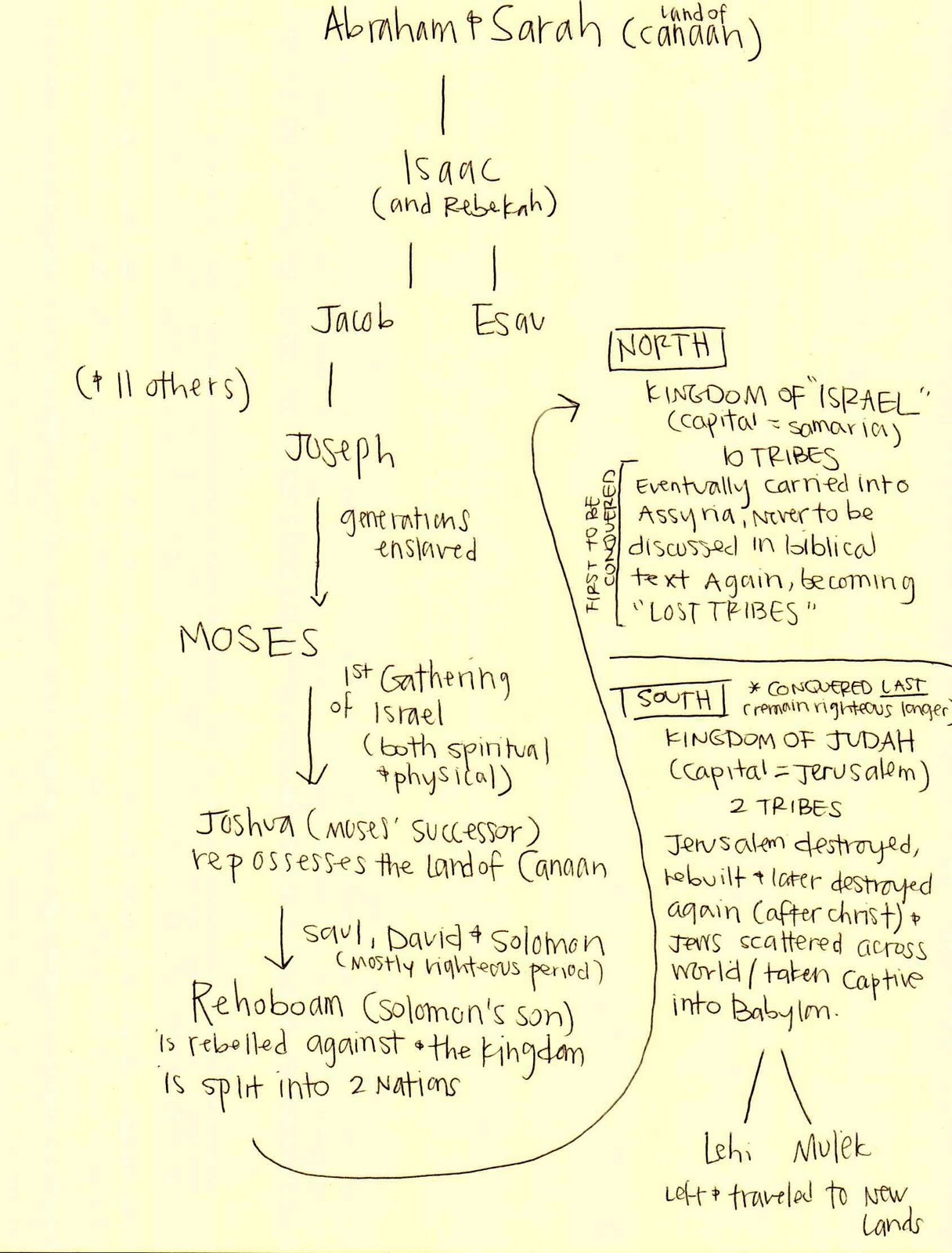
What happened to these 12 tribes, how did most of them ultimately become known and the "10 Lost Tribes?"
...how the house of Israel was scattered

Abraham and Sarah chart 
(*click to get larger image)


We know that the house of Israel must be gathered (Jeremiah 23:3), but why is this so?  Why does the Lord want his people to be gathered?  What are some of the Lord's purposes for the gathering of Israel?
- [for his children] To learn the teachings of the Gospel
- To prepare to meet the Savior
- To build temples and perform sacred ordinances
- To strengthen one another and be unified in the Gospel, finding protection from unrighteous influences
- To prepare to share the Gospel with others


This, the gathering of Israel can not be done without the proper authoritySo then we must ask, is the proper authority present, and has the work begun?  That would be an emphatic yes.  When, then, was the authority restored and to whom was it restored?
-From D&C 110:11, we learn that Joseph Smith received this authority in the Kirtland temple on April 3, 1836 from Moses (this was also when Elias and Elijah appeared to restore other keys)

Once the authority to gather Israel was given, the work had to move forward.  How exactly did the gathering of Israel begin to move forward?
-This answer is two part.  We first must understand that the gathering of Israel has two meanings.  The first is meaning is spiritual, the second physical.  Before the physical gathering, there must be a physical gathering.  Which, leads us to ask, how is Israel being spiritually gathered? 
    -Missionary work, the building of temples and the ordinances/covenants made therein are the HOW in this equation.  They both continue to move forward at astonishing rates, allowing Israel to learn the Gospel, come unto Christ, be baptized, and keep the commandments, which are all things that must be done in order to gather Israel spiritually.

The physical gathering began with Joseph Smith and the early pioneering Saints as they began to gather Israel first in Ohio, then in Missouri, and eventually in Salt Lake City.  However, as time passed and the work moved forward the physical meaning of the gathering of Israel changed a bit.  Perhaps as a result of modern technology (or maybe the modern religious laws which provide freedom and protection), it was declared many times that the physical gathering was no longer to imply that the saints needed to leave their home lands.  Elder Russell M. Nelson said:
  “The choice to come unto Christ is not a matter of physical location; it is a matter of individual commitment. People can be ‘brought to the knowledge of the Lord’ [3 Nephi 20:13] without leaving their homelands. True, in the early days of the Church, conversion often meant emigration as well. But now the gathering takes place in each nation. … The place of gathering for Brazilian Saints is in Brazil; the place of gathering for Nigerian Saints is in Nigeria; the place of gathering for Korean Saints is in Korea; and so forth. Zion is ‘the pure in heart.’ [D&C 97:21.] Zion is wherever righteous Saints are” (in Conference Report, Oct. 2006, 85; or Ensign, Nov. 2006, 81).

We now have the literal and spiritual gathering of Israel throughout the world.  But when will the gathering be complete?  
- Not until the 2nd coming of Christ and on into the Millennium ( Joseph Smith—Matthew 1:37)
- People will be "gathered home to the lands of their inheritance, and shall be established in all their lands of promise" (2 Nephi 9:2), the tribes of Ephraim and Manasseh will be gathering in the Americas, the tribe of Judah will return to the city of Jerusalem (and the area surrounding it), and the lost ten tribes will receive from the tribe of Ephraim their promised blessings (D&C 133:26–34).

(If there is time left, I will spend a few moments on the conversion processes necessary in the gathering of Israel.  In doing so I'll ask if anyone would like to share their own conversion story...)

How wonderful it is to witness these prophetic miracles!  To see the Gospel of Jesus Christ spread through out the world is simply marvelous.  The gathering began more than a hundred and fifty years ago and in that short time much has been accomplished.  While there is much still left to be done, there have been infinite strides and miracles made from the pioneers through to this very day.  Hearing new temples being established every six months and watching people flock to them astounds and amazes me.  Witnessing the conversion of saint's everywhere brings me to tears.  Our Heavenly Father absolutely loves us and is extending his arms to us, calling us together and inviting us home.  How grateful I am to witness these things, to feel His love, and to have a testimony of the fulness of times.  In deed, this is a marvelous work and a wonder.

This lesson is what I would call scripture heavy.  The Bible, Book of Mormon and Doctrine and Covenants are all used several times-far more than what I have included.  In your personal study you might want to read:
In my study I referenced a couple really great talks in addition to the Gospel Principles Manual.  I read/used: Gathering Scattered Israel: Then and Now, by Paul K. Browning and The Gathering of Scattered Israel, by Russell M. Nelson as well as Lesson 12: “The Gathering of My People”  from the Doctrine and Covenants and Church History Teacher's Manual.


Sunday, October 2, 2011

Temple Work and Family History

Many people spend their whole lives wondering why they are here (on Earth) and where they are going. What a blessing to have the answer key to that final test tucked away in our files. We know the who, what, when, where, why and how. So let's review what we know.

Who are we ALL? (Children of our Father in Heaven who loves us and wants us to return to him)
Why are we here? (To gain physical bodies, to become like Christ, to make and keep covenants, and to eventually return to our Father in Heaven)
What are we asked to do? (be baptized, make temple covenants)
How can we ALL do these things? (Make the choices necessary to enter the temple, receive our own endowments then do the work for those who didn't have the opportunity to do it themselves)
When are we to do these things? (Now, as soon as we can)
Where are we to do these things? (In the temple of the Lord)

How many of us have pictures of the temple in our home? Now, how many of the temples adorning our walls are of the very temple we were married in? I would surmise that our tendency is to develop a special attachment to the temple we made our own covenants in. Whether it's where our families were sealed or where we received our endowments (or even where we performed baptisms in our youth), the temples we have personally been in have more meaning to us.

Why is this?

I think we get it. We get that a wedding, a marriage, is more than just an earthly status. We understand not only the importance of temple work, but the importance of OUR OWN covenants. Receiving the knowledge we need and making the covenants necessary for our salvation and for the eternal bond with our families means more to us than anything else. The time and place where we made these covenants and first learned the next steps in returning to our Father in Heaven is extremely significant to us.

If we feel this way about our own experiences and relationship with the Lord, we absolutely are able to understand how others who have yet to receive these blessings must feel. We want, and need, to allow them the same opportunities and experiences as we have. It is our duty and our pleasure to stand in for them and to perform the ordinances they were unable to perform while in this life. By doing so we are giving them the chance to accept the gospel and live with God again.

Returning to the temple often is a service to our ancestors that cannot be fulfilled any other way. They need us to help them along their way. However, we also need them. Imagine if everyone had the opportunity in this life to be baptized, receive their endowments and be sealed to their eternal companion. Imagine if the only temple word to be done was our own. Do you think you could comprehend all that you need to know in one session at the temple? Do you think you'd never want to return for more instruction and to seek the Lord's guidance again? I think not. What a joy and a pleasure to be able to do this work and to be given the opportunity to continue to learn and prepare to meet our Savior.

Temple Ordinances Seal Families Together Forever

What does it mean to be sealed?  Let’s talk about the sealing power.

Matthew 16:19
And I will a
give unto thee the bkeys of the ckingdom of heaven: and whatsoever thou shalt dbind on earth shall be bound in heaven: and whatsoever thou shalt loose on earth shall be loosed in heaven.

***My experience at a sleepover in high school with a friend

D&C 128:9
9 It may seem to some to be a very bold doctrine that we talk of—a power which records or binds on earth and binds in heaven. Nevertheless, in all ages of the world, whenever the Lord has given a a
dispensation of the priesthood to any man by actual revelation, or any set of men, this power has always been given. Hence, whatsoever those men did in bauthority, in the name of the Lord, and did it truly and faithfully, and kept a proper and faithful record of the same, it became a law on earth and in heaven, and could not be annulled, according to the decrees of the great cJehovah. This is a faithful saying. Who can hear it?

“…This sealing power, restored in this dispensation by Elijah the Prophet (D&C 2:1-3; 110:13-16), is the means whereby ‘All covenants, contracts, bonds, obligations, oaths, vows, performances, connections, associations, or expectations’ attain “efficacy, virtue, or force in and after the resurrection from the dead (D7C 132:7).” (Boyd K. Packer, The Holy Temple)

The temple is the place for this great work to be accomplished but it would be fruitless if done without the proper authority/keys of the priesthood. When done in the right place AND with the proper authority, this vicarious work allows us to be bound to Heaven. When we say that something/someone is "sealed" we mean that the same covenants/promises made on Earth are, in essence, still in effect when we pass on from this probationary state and into the eternities to live with our Father in Heaven.

“The use of a seal is a visible means of signifying that the document is authoritative, that it is worthy of respect and recognition, that its effect is binding.  Seal is the right word, therefore, to be used to represent spiritual authority.  In this case it is not represented by an imprint, by a wax impression, by an embossment, or by a ribbon; nor by an engravement on a signet, or by a stamp, or by a gold design pressed onto a document.  The seal of official authority relating to spiritual matters, like other things spiritual, can be identified by the influence that is felt when the sealing power is exercised.” (Packer, The Holy Temple page 88)

Has anyone ever thought of the Holy Ghost’s witness or the influence our covenants have on our daily lives as the seal?

It is not enough to be baptized. We also need to enter the temple and receive our endowments. These two things are preparatory for the later, most significant covenants we make with our spouse and with the Lord as we are married and SEALED for all eternity. It is this sealing that is most vital. It not only offers us the opportunity to live with God in the Celestial Kingdom, it allows our spouse and our children the right and privilege to do so as well, with us...as long as we keep out covenants and live worthily to do so.

Once a couple is sealed, all the children they subsequently have are sealed to them. Any adopted children can be sealed to them in the temple as well. Couples that are married civilly can prepare themselves and their children to be worthy to enter the temple and be sealed together.

(What must a couple do to make the sealing power affective in their marriage?)

Our Ancestors need our help
Again, these covenants we make; the blessing of being sealed to our families, are so profound, so life changing, the Lord wants everyone to have the opportunity to partake in the joy. The bliss that results from these choices is eternal and is exactly what our Father in Heaven would choose for us. But there simply is no way to share the gospel with everyone who has ever walked the Earth, not in this life at least. So what genius plan did God come up with to solve this problem? He allows his children to be taught in the spirit world after they leave mortality. He gives them the chance to hear the gospel and choose whether or not to accept it.
However, those that accept the gospel in the spirit world still need the sealing ordinance performed on earth if their covenants are to be bound in Heaven (allowing them to progress and live eternally with our Father in Heaven}. That is why we need to do temple work. Imagine how many people have accepted the gospel and are still waiting for someone to do their work for them!  My brain could hardly fathom the 110,000 people in the Michigan stadium for the Michigan VS Notre Dame game last night, let alone centuries of the Earth's population sitting in a chapel in the sky waiting for us to take care of them. There is much work to be done, but we can do it!  We just need to know where to start.

(How does the Plan of Salvation show God's justice, compassion and mercy?
What experiences have you had doing temple work for your ancestors?)

Where do we begin?

So once we get the family history/temple work bug, where should we start?

There are 3 basic steps:
1. Identify our ancestors
2. Find out with ancestors need temple ordinances performed
3. Make certain the ordinances are performed for them
Starting your family history work is often easier if you ask your ward/branch family history consultant or bishop/branch president for direction.

Identify our Ancestors
We need to go through our homes and see what kinds of documents, certificates, family heirlooms, journals etc. we already have that might give us names and other information. We can also talk to relatives, visit a church family history center, or go to familysearch.org
"How much we learn will depend on what information is available to us. We may have only a little family information and may be able to do no more than identify our parents and grandparents. If we already have a large collection of family records, we may be able to identify ancestors from generations further back in time.
We can keep track of the information we gather on family group records and pedigree charts." (manual)

Find Out Which Ancestors Need Temple Ordinances Performed
Temple ordinances have been performed for the dead since the early days of the Church. Consequently, some ordinances for our ancestors may have already been done. To find out which ancestors need temple ordinances, we can look in two places. Our own family records might have information about what has been done. If not, the Church has a record of all ordinances that have been performed in the temple. Your ward or branch family history consultant can help you in this effort. (manual)

Make Certain the Ordinances Are Performed
Many of our ancestors in the spirit world may be anxious to receive their temple ordinances. As soon as we identify these ancestors, we should arrange for this work to be done for them.
One of the blessings of family history work comes from going to the temple and performing ordinances in behalf of our ancestors. We should prepare ourselves to receive a temple recommend so that, when possible, we can do this work. If our children are 12 years old or older, they can share in these blessings by being baptized and confirmed for their ancestors. (manual)
If it is not possible for us to go to the temple to participate in the ordinances, the temple will arrange to have the ordinances performed by other Church members.

How has the Lord helped you or members of your family find information about your ancestors?

If all of this sounds a bit intimidating to you too, take president Packer’s advice:
1.      Start with yourself.  Over time, fill a box with every record/document/photo etc. about yourself.
2.      Divide it into 3 parts: child, youth, adult
3.      Start with the child, work towards adult, and put everything in chronological order
4.      Take what you’ve created and write a simple life story
“Once you begin this project, very interesting and inspiring things will  happen.  You cannot do this much without getting something of the spirit of it, and without talking about it, at least in your family circle.  Some very interesting things will start to happen once you show some interest in your own family history work.  It is a firm principle.  There are many, many testimonies about it.  It will happen to you” (Packer, Ensign article)

Family History Basics/Responsibilities
1.      Each of us is to compile his or her own life history
2.      Each of us is to keep a book of remembrance
3.      As individuals and families we are each to see our our kindred dead, beginning first with the four most recent generations on each line, and the going back as far as we can.
4.      We are each to participate in other programs such as name extraction when asked to do so.
5.      We are to organize our families and hold meetings and reunions.
6.      If we have access to a temple, each of us should go to the temple as often as possible to do ordinance work—first for ourselves, then for our progenitros, then for al the names that have been gathered by means other than our own. (Packer, Ensign article)

Additional Family History Opportunities
What are some simple ways for someone with many other responsibilities to participate in family history work?
In addition to providing temple ordinances for the ancestors we know about, we can help those in the spirit world in many other ways. We should seek the guidance of the Spirit as we prayerfully consider what we might do. Depending on our circumstances, we can do the following things:
  1. Attend the temple as often as possible. After we have gone to the temple for ourselves, we can perform the saving ordinances for others waiting in the spirit world.
  2. Do research to identify ancestors who are more difficult to find. Family history consultants can guide us to helpful resources.
  3. Help with the Church’s indexing program. Through this program, members prepare genealogical information for use in the Church’s family history computer programs. These programs make it easier for us to identify our ancestors.
  4. Contribute family history information to the Church’s current computer programs for family history. These programs contain genealogies contributed by people all over the world. They allow people to share their family information. Family history consultants can provide more information about the Church’s computer programs.
  5. Participate in family organizations. We can accomplish much more for our ancestors as we work together with other family members.
Think about what you can do to increase your participation in temple and family history work.

Additional Scriptures
1 Peter 4:6 (gospel was preached to the dead)
1 Corinthians 15:29; D&C 128:15–18 (work for the dead)
D&C 138 (redemption of the dead)

Quotes, Stories etc. shared:

“You believe in the Resurrection.  You must know that baptism for someone who is dead is quite as essential as baptism for someone who is living.  There is no difference in the importance of it.  One by one it must happen.  They must do it here while living, or it must be done for them here after they die.  The whole New Testament centers on the Resurrection of the Lord.  The message is that ALL are to be resurrected.  Every scripture and every motivation that apply to missionary work have their application to ordinance work for the dead.” (President Packer, Ensign article)
“Somewhere I heard of an incident that happened in WWII.  A group of commandos were sent across the English Channel to accomplish a military mission.  They were sent shore at night in high seas and had to make their way across a treacherous reef.  When the first of them reached the beach, led by a sergeant, they heard a companion calling for help.  He was caught up on the reef and was unable to free himself.  If left to himself he would be dashed to pieces by the heavy seas against the reef.  The sergeant pulled off his gear in preparation for an attempt to rescue the man.  One of those on the beach said, ‘Don’t go out there—it’s too dangerous and difficult.  If you go out there you’ll never come back.’  The sergeant replied, ‘I don’t have to come back.  I just have to go out there.’”
This illustrates something of our position with regard to our doing the work of the Lord.  We are commanded to preach the gospel to all the living, for example.  We see no way to accomplish this task in our lifetime.  Many refuse to listen, some turn away, others resent and ever persecute us.  Nevertheless we are not released from the assignment to try.  We are to do the best we can.  If we do, the honest in heart can be found and sifted out of the world.” (President Packer, The Holy Temple, page 234)
If you don’t know where to start, start with yourself. If you don’t know what records to get, and how to get them, start with what you have. (President Packer)

I do not believe in entitlements.  The word itself makes me cringe.  However, there are a few exceptions to my rule.  One of the exceptions, one of the things EVERY person who has ever lived is entitled to is the Gospel.  Every man, woman and child is entitled to hear the words of the Lord, to hear his gospel plan. 
“The Lord has made it known that his mercy extends to the uttermost bounds and that every soul is entitled to hear the gospel plan, either in this life or in the spirit world.  All who hear and believe, repenting and receiving the gospel in it fullness, whether living or dead, are heirs of salvation in the celestial kingdom of God.”
It is thus, our duty to see to it that this entitlement is kept.  That is one tax, I’m willing to pay.

Monte J. Brough Ensign article 1994

Members Guide To Temple and Family History Work
President Packer Talk